Despite metros being a very safe mode of transport, any incident, however rare, can attract significant public attention and erode trust. The study examines passenger safety incidents within stations, focusing on vertical circulation (escalators and stairs) and platform-train interface gaps. It builds upon findings from COMET’s Safety Performance Indicator (SPI) analysis using additional member contributions to identify trends, underlying causes, and effective strategies for reducing the risk of passenger safety incidents.
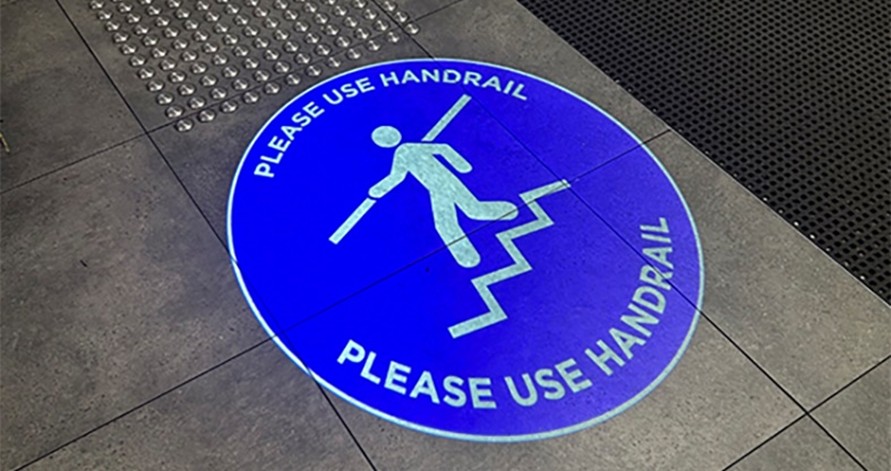
Example image of gabo light projection at Sydney Metro
In the past two decades, metros around the world have been transforming the way they approach safety and security. One key aspect of that is the use of emerging technologies, such as video analytics. The COMET case study brings together responses from 34 member metros and covers the challenges, solutions, and best practices related to video analytics in metros, including a range of examples of using Artificial Intelligence.
Video analytics have specific impacts on different types of incidents and wider impacts on metro systems. The study reviewed areas where video analytics had reported impacts. 71% of the responding metros reported video analytics to be ‘very effective’ in enhancing their safety and security, and identified future opportunities for further development of video analytics in their systems.
Managing security – and perception of security – is a growing challenge for many metro operators. In North America and Europe where crime and disorder is a significant concern for metros, perception of security in public spaces has been influenced by wider quality-of-life issues that pre-dated COVID-19 related to homelessness, drug and alcohol use and mental health. The pandemic also raised new challenges of staff unavailability and lower ridership which reduced the presence of ‘active bystanders’ on metro networks.
Factors influencing crime in metros
As such, the study aims to understand changes in crime and anti-social behaviour since the pandemic began, and to share initiatives implemented by metros to reduce incident rates and to improve customer perceptions of personal safety. This report contains data compiled from twenty-seven COMET members, including an in-depth interview with the Deputy Chief of Police at San Francisco BART. It reviews factors impacting crime in metros, key barriers to improving security, incident rates during pandemic, as well as opportunities and actions to combat crime and disorder.
The highest risk area to passenger safety within metro systems is upon entering the track area with an average of one track intrusion per million passenger journeys across CoMET/Nova metros. Platform Doors (PD) remove this risk but their cost, complexity of planning and installation, station design and other challenges constrain their wide-spread installation: 70% of CoMET and Nova members have no or low PD coverage. For many metros, PDs come at the expense of other critical infrastructure projects. This case study explored the best practice on managing platform safety risk without the use of PDs.
On average, 65% of track intrusions for respondent metros are intentional customer actions, requiring mitigation measures to instil a behavioural change. Classified as passive prevention measures, these consist of platform announcements and reminders, poster campaigns and platform-edge markings or lighting.
Beyond these, the study identified active detection methods enacted by staff members or detection and response technologies. Combining Smart CCTV, lasers and microwave frequency was successfully piloted as a means to detecting the presence of any person or object on the track. The use of these technologies has proven effective to increase safety in the absence of PDs.
Safety still remains a challenge despite sizeable investments in making the equipment and hardware safer for metros. The most significant barrier to enabling a continuous improvement in safety is to understand and alter the safety culture of the organisation. A model for the improvement of an organisation’s safety culture was developed through the study.
A reasonable level of safety may be achieved through adherence to external regulations, robust processes, good training schemes and an organisational structure which devotes senior management attention safety, defining an organisation ‘practicing safety’. However, a culture which constantly prioritises safety and is aware of the implications of every action it takes is hard to build and maintain.
To fully become an organisation that is always ‘thinking safety’, three key linked behaviours are required, including (1) excellent measuring and monitoring of safety performance, which, in turn, enables (2) the transparent enforcement of standards in a fashion which balances safety and individual accountability, feeding into (3) a robust procedure to investigate and learn from errors.
Continual effort is required to improve in all areas of the safety culture model. The creation of trust is key to enabling a good safety culture, alongside a balance between enforcement of standards and practices and accountability of actions.
Our site uses functional and strictly necessary cookies only. For more details on the cookies we use, please see our cookie notice.